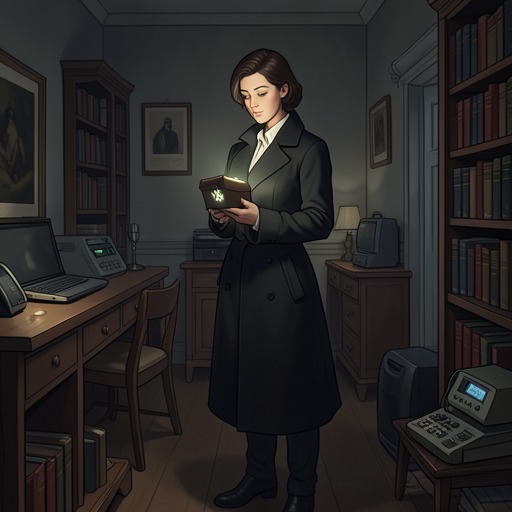
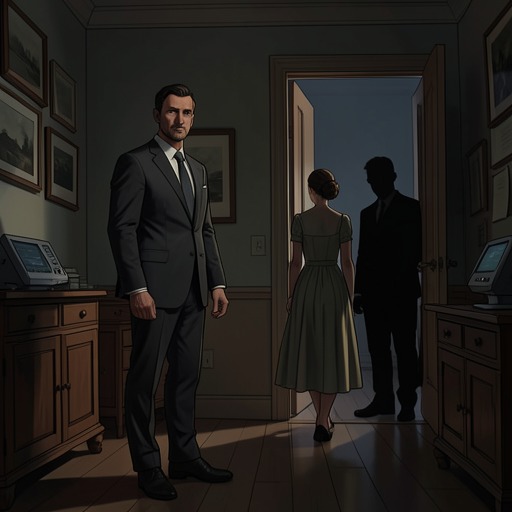
Gareth Lawler recognizes Jane at Paddington Station
Panic RoomGareth Lawler’s sighting of Jane Glasson at Paddington turns a long absence into an unsettling certainty: after twenty-two years, he sees her alive, recognizes her, and watches her deliberately deny their shared past. The encounter offers proof to Gareth but no reunion. Its decisive movement is from recognition to evasion, leaving him with the knowledge that Jane Glasson survives and the equally forceful evidence that she does not want to be found.
The Disclosure and Its Stakes
The account comes out when Gareth is asked what he wanted with Ingrid Denner. After the question is put to him again, he accepts the chance to tell what he knows. He rubs his eyes beneath his glasses, adjusts them, and explains that a couple of months earlier he saw Jane Glasson at Paddington. The small, physical hesitation precedes a disclosure with consequences: Gareth is not offering a vague resemblance or a rumor, but claiming direct knowledge that she is alive.
His certainty is tied to a history of looking for her, even if, as he describes it, that search had become subconscious. Over the years he continued to hope that Jane Glasson would re-enter his life. He admits that she was not easy to forget, though there had been a time when he thought he might. His awkward turn toward middle age, which he describes as closing on a person like a vice, briefly makes the telling about his own disappointments as well as her disappearance. He catches himself and apologizes for self-pity; the apology does not diminish the emotional weight he attaches to the sighting.
Recognition at Paddington
Gareth had been waiting for a train to Cardiff on a business trip. He was seated on the concourse beneath the departures board when he noticed a woman in the row ahead, working on an iPad. The day was wet. She wore a shiny black raincoat and a Hermès scarf, and had a small wheelie suitcase with a bag looped over its handle. Her fair hair, darker in places and shaped to her neck, first recalled someone familiar. Gareth initially expected the resemblance to dissolve when he saw her face.
Instead, he walked around the end of the row and recognized Jane Glasson as soon as she looked up. He recalls her as older but otherwise essentially unchanged, and contrasts her appearance with how much he believes he himself has altered. In his recollection, the force of the moment lies in the gap between expectation and confirmation: he had approached prepared to discover a stranger, yet her face made his recognition immediate. His description of her as his beautiful Jane conveys not just recognition but the intimacy that remained in his memory after the long separation.
Denial and the Failed Pursuit
Jane Glasson had already seen Gareth looking at her. He believes their eyes met for a split second and that, before he spoke, he understood she would deny being the person he knew. When he approached, she closed her iPad and looked up with an expression of apparent uncertainty. Gareth called her by name and identified himself; she answered that she did not know him and said he had mistaken her for someone else. He insists that the voice was Jane Glasson’s, even as her words rejected the identity he was trying to restore.
She gathered her belongings and started away. When Gareth stepped into her path and asked what had happened, she again denied knowing what he meant and asked him to move. She then walked across the concourse toward the platforms. A large man who had overheard the exchange intervened, telling Gareth to leave her alone. Gareth judged him imposing enough not to challenge, retreated toward the shops, and continued watching Jane Glasson over his shoulder. Her departure was therefore shaped both by her own denial and by the stranger’s intervention, which stopped Gareth from following immediately.
Once the man’s attention moved elsewhere, Gareth followed Jane Glasson toward the Heathrow Express platform. His business trip to Cardiff had ceased to matter; he was thinking instead about where she had been for the preceding twenty-two years, why she was pretending not to know him, and whether he could possibly be mistaken. He boarded the train and searched through three or four carriages. The doors closed shortly before departure, and the train began to move before he found her.
Separation and Significance
Only as the train pulled away did Gareth see Jane Glasson back on the platform, walking toward the concourse and looking straight ahead. He cannot tell whether she had boarded and got off at the last moment or had never boarded at all. He banged on the train door, but she did not look toward him. The accelerating train made the separation literal: the more certain Gareth became that he had found her, the less able he was to reach her.
Gareth believes she may have lured him onto the train, but presents that as his interpretation, not as something he can prove. He had to continue to Heathrow, waited there for the next train from Paddington in case she was aboard, and returned to Paddington when she was not. By then he had lost his chance to find her. He allows that she might have evaded him whatever he did, while also recognizing that the encounter’s apparent trick confirmed his own memory: without it, he says, he might later have doubted what he had seen.
The recollection ends with a distinction between certainty and evidence. Gareth says that he has replayed the incident several times a day and told friends who think he is imagining it; nevertheless, he is completely certain Jane Glasson is alive. He also believes she does not want anyone to know. He cannot offer her father proof, so the sighting changes what Gareth knows without resolving what he can establish to anyone else. The scene thus makes Jane Glasson’s survival known to the reader through Gareth’s testimony while keeping her chosen concealment intact.